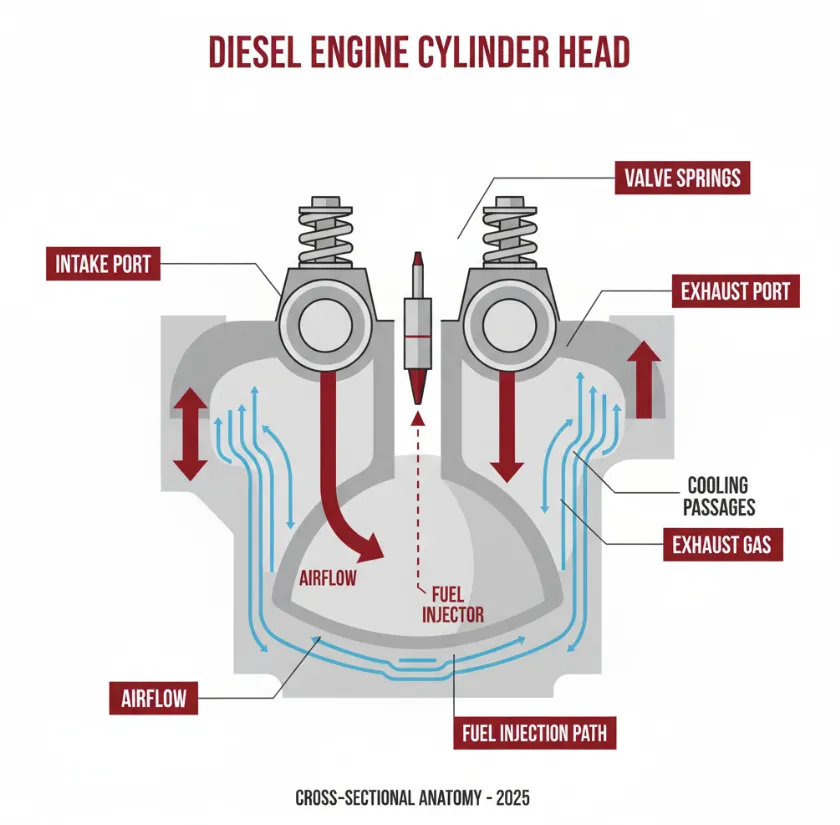
A diesel engine cylinder head is one of the most failure-prone components in heavy-duty engines. Unlike simpler parts, the cylinder head operates under extreme thermal stress, combustion pressure, and coolant system pressure simultaneously. When it fails, the entire engine is disabled.
Most cylinder head failures are preventable—if you know what to look for and when to act. This guide covers the 7 most common cylinder head problems, such as the Cummins ISF 2.8 cylinder head (OEM 5271176), their root causes, exact symptoms, and the OEM part numbers you need for replacement—supported by Volgen Power.
Quick Answer
The most common diesel cylinder head problems, such as the Cummins ISF 2.8 cylinder head (OEM 5271176) are: (1) Combustion chamber cracking from thermal fatigue, (2) Head gasket failure causing coolant loss, (3) Valve seat erosion from high mileage, (4) Warpage from overheating, (5) Coolant passage corrosion causing internal leaks, (6) Cylinder head bolt failure, and (7) Oil passage clogging from sludge buildup.
- OEM cylinder heads range USD 450–3,200 depending on engine brand
- Most problems are preventable with coolant maintenance at 2-year intervals
- Cracked cylinder heads under 50mm can often be welded rather than replaced
- OEM part numbers for all major brands are cross-referenced below in this guide
Table of Contents
7 Most Common Diesel Cylinder Head Problems
Problem 1: Combustion Chamber Cracking (Thermal Fatigue)
What it looks like: White exhaust smoke, loss of engine power, misfiring in one or more cylinders, and visible cracks when the cylinder head is removed for inspection.
Why it happens: The combustion chamber experiences temperature swings from 90°C (coolant temperature) to over 2,000°C (combustion peak) every engine cycle. Over time, thermal fatigue causes micro-cracks in the cylinder head, especially in the bridge areas between adjacent cylinders where temperature gradients are highest. In older engines, this is compounded by using the wrong coolant type or running without anti-corrosion additives.
How to fix it: Small cracks under 30mm and not in the combustion chamber sealing surface can be repaired by a machine shop using TIG welding or cold-seal compounds. Cracks in the combustion chamber floor, near valve seats, or longer than 50mm require full replacement. Always pressure-test the head at 4-6 bar before deciding on repair vs. replacement.
Problem 2: Head Gasket Failure — Coolant Loss Without External Leaks
What it looks like: Engine overheats within minutes of starting, coolant reservoir empties without puddles under the vehicle, white milky oil residue on the oil filler cap, and white smoke from the exhaust.
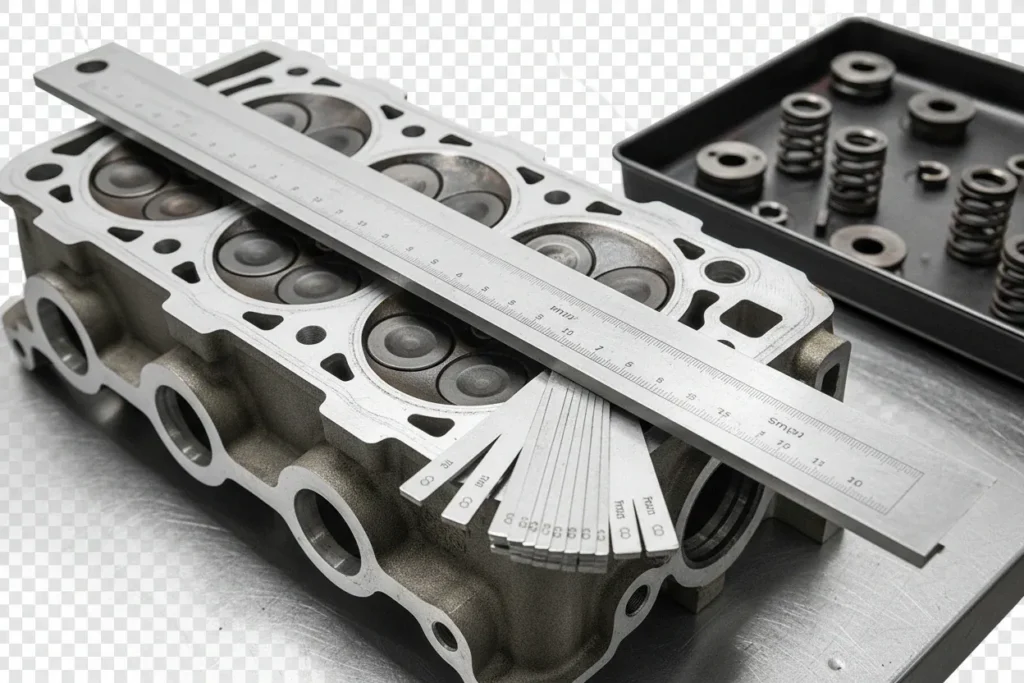
Why it happens: The head gasket seals the cylinder head to the engine block, containing combustion pressure on one side and coolant/oil passages on the other. When the cylinder head warps (usually from overheating), the gasket seal fails. Even a 0.05mm warpage is enough to compromise the seal. Common triggers include: running with low coolant, a failing thermostat, or a collapsed radiator hose.
How to fix it: Replace the head gasket and inspect the cylinder head mating surface for warpage using a precision straight-edge and feeler gauge. If warpage exceeds 0.05mm, the head must be resurfaced (milled). If the head is cracked beyond repair, replace it. Always replace head bolts — never reuse old bolts as they stretch during tightening.
Problem 3: Valve Seat Erosion (Valve Recession)
What it looks like: Loss of compression in one cylinder, rough idle, reduced engine power, and decreased fuel efficiency. On the compression test, one cylinder reads significantly lower than the others.
Why it happens: Valve seats cool the valve and create a gas-tight seal between the valve and cylinder head. Over time, especially in high-mileage engines (over 500,000 km), valve seats erode. This is accelerated by using leaded fuel (where applicable), incorrect valve clearance settings, and running engines at consistently high RPMs. The problem is particularly common in older Cummins 6BT and NT855 engines that haven't had their valve clearances checked regularly.
How to fix it: A machine shop can grind the valve seats and install new valve seat inserts. Valve clearance should be checked and adjusted after reassembly. For high-mileage heads with severely eroded seats, replacement is more cost-effective than repeated repairs.
Problem 4: Cylinder Head Warpage from Overheating
What it looks like: Repeated head gasket failures even with new gaskets, coolant loss after hard driving, and a visible bow in the cylinder head mating surface when checked with a straight-edge.
Why it happens: When an engine overheats, the cylinder head expands unevenly — the center heats up faster than the edges, causing the head to bow upward in the center. Once the head is warped, no gasket can maintain a seal. Even a single overheating event can cause permanent warpage. Common causes: faulty thermostat, failing water pump, collapsed radiator hose, or running with insufficient coolant.
How to fix it: Check warpage with a precision straight-edge and feeler gauge. Warpage under 0.05mm can be corrected by resurfacing the head at a machine shop (typically USD 150-400). Warpage over 0.08mm requires head replacement. Check the engine block deck surface as well — if the block is also warped, both components need attention.
Problem 5: Coolant Passage Corrosion and Electrolysis Damage
What it looks like: Coolant turns brown or dark green quickly after changing, the engine overheats even with a new thermostat, and internal corrosion deposits are found when the head is removed.
Why it happens: When incompatible coolants are mixed (e.g., organic acid technology coolant mixed with older silicate-based coolant), electrolysis occurs. This creates micro-electrical currents that literally eat away at the aluminum or cast iron in the cylinder head's coolant passages. The result is corroded passages, reduced coolant flow, and eventually internal coolant leaks into the oil or combustion chamber.
How to fix it: Drain and flush the entire cooling system with a neutralizing flush solution. Never mix coolant types. Replace the cylinder head if corrosion has perforated the coolant passages. Install a new thermostat and water pump if they show signs of corrosion. Use only the manufacturer-specified coolant type going forward.
Problem 6: Cylinder Head Bolt Failure (Broken or Stretched Bolts)
What it looks like: Coolant or oil leak at the cylinder head-to-block junction, loss of compression, and white smoke from the exhaust. On inspection, head bolts show signs of corrosion, stretching, or breakage.
Why it happens: Cylinder head bolts must be tightened to precise torque specifications with calibrated tools. Bolts that are over-torqued become brittle and break; those under-torqued stretch and lose clamping force. In high-mileage engines, bolts can corrode and become difficult to remove, leading to snapped bolt heads during repair attempts.
How to fix it: Broken head bolts require extraction using a specialized bolt-out kit or left-hand drill bits. This is a job for an experienced mechanic — broken bolts in the block can cause catastrophic damage if not removed correctly. Always use new head bolts (never reuse) and follow the manufacturer's torque sequence and tightening specification.
Problem 7: Oil Passage Clogging and Oil Starvation
What it looks like: Low oil pressure warning light, noisy lifters (tappets), and reduced oil pressure at idle. Symptoms are often misdiagnosed as crankshaft or camshaft problems.
Why it happens: The cylinder head contains oil passages that supply lubricant to the camshaft, valve lifters, and rocker arms. Over time, sludge and carbon deposits accumulate in these passages, restricting flow. This is common in engines that have gone too long between oil changes, or in engines that have run on low-quality lubricants. Restricted oil flow causes metal-to-metal contact, leading to camshaft lobe wear and lifter failure.
How to fix it: Remove the cylinder head and have the oil passages pressure-tested and cleaned. Severe clogging may require replacement of the cylinder head. Change oil and filter at manufacturer-specified intervals (typically every 15,000-20,000 km for heavy-duty diesel engines) to prevent recurrence.
How to Identify Which Problem Your Engine Has: Step-by-Step Diagnosis
Before ordering a replacement cylinder head, confirm the exact problem. Here is the diagnostic sequence used by professional diesel mechanics:
- Compression test — Test each cylinder individually. Low compression in one cylinder indicates head gasket failure or valve seat damage. Low compression in all cylinders suggests piston ring wear, not head damage.
- Coolant system pressure test — Pressurize the cooling system with the engine cold and watch for pressure loss. Rapid pressure loss with a cold engine indicates a head gasket leak.
- Oil analysis — Check the engine oil for coolant contamination (milky appearance) or fuel dilution (thin, low-viscosity oil). Both indicate head gasket failure.
- Visual inspection of head mating surface — Remove the cylinder head and inspect for warpage (use a precision straight-edge), cracks (dye-penetrant test), and corrosion.
- Pressure test the cylinder head — Block off all passages and apply 4-6 bar pressure. Submerge in water — bubbles indicate cracks.
Cylinder Head Repair vs. Replacement: Decision Guide
Not every damaged cylinder head needs full replacement. Use this decision matrix to choose the right approach:
| Condition | Repairable? | Estimated Repair Cost | Replacement Required If... |
|---|---|---|---|
| Crack in the combustion chamber floor or near coolant ports | Yes — weld repair | USD 200-500 | Multiple cracks/combustion chamber damage |
| Warpage under 0.05mm | Yes — surface grinding | USD 150-400 | Warpage exceeds 0.08mm |
| Valve seat erosion | Yes — seat grinding + valve job | USD 300-700 | Mileage over 800,000 km with multiple seat damage |
| Corroded coolant passages | Possibly — flush and test | USD 100-300 flush | Perforated passages or severe internal corrosion |
| Multiple cracks / combustion chamber damage | No — replace | — | Full replacement required |
| Commercial fleet / high-utilization vehicle | — | — | Always replace (minimize repeat failures and downtime) |
OEM Cylinder Head Cross-Reference: All Major Brands
Use the tables below to find the exact OEM part number for your engine. All parts are verified against manufacturer databases. Lead times and pricing vary by quantity and destination.
Cummins Cylinder Heads — Full Cross-Reference
| Engine Model | OEM Part No. | Displacement | Compatible Applications | Weight (Est.) | Est. Price (USD) | Lead Time |
|---|---|---|---|---|---|---|
| NT855 | 3411798 | 14L / 855 cu in | Heavy-duty industrial, marine, mining truck | ~68 kg | 1,850-2,400 | 3-7 days |
| ISF 2.8 | 5271176 | 2.8L | ISF 2.8 light commercial truck, delivery vehicle | ~32 kg | 680-880 | 3-5 days |
| ISF 3.8 | 5271866 | 3.8L | ISF 3.8 commercial truck, school bus, light industrial | ~42 kg | 780-980 | 3-5 days |
| 6BT 5.9L | 3966454 | 5.9L / 359 cu in | 6BT industrial engine, heavy truck, agricultural equipment | ~45 kg | 520-720 | 3-7 days |
| 6CT 8.3L | 3973493 | 8.3L | 6CT heavy truck, bus, industrial generator | ~55 kg | 680-900 | 3-7 days |
| ISB 5.9L | 3957386 / 4981626 | 5.9L | ISB mid-range truck, transit bus, RV | ~48 kg | 620-820 | 3-7 days |
| ISX15 / QSX15 | 4962732 / 4331187 | 15L | Heavy-duty highway truck, mining dump truck, locomotive | ~85 kg | 2,200-3,200 | 7-14 days |
| QSK60 | 5372485 | 60L | Large industrial engine, power generator, marine vessel | ~120 kg | 2,800-3,600 | 7-14 days |
| K19 | 3640321 | 19L | K19 large bore industrial, mining equipment | ~95 kg | 2,400-3,200 | 7-14 days |
For Cummins ISF specifically: Cummins ISF Cylinder Head Buyer's Guide: 2.8L and 3.8L Specifications, Problems and OEM Part Numbers
Volvo Cylinder Heads — Full Cross-Reference
| Engine Model | OEM Part No. | Displacement | Compatible Applications | Weight (Est.) | Est. Price (USD) | Lead Time |
|---|---|---|---|---|---|---|
| Volvo D11 | 21576282 | 10.8L | FM truck, FMX truck, mid-range distribution | ~72 kg | 2,100-2,800 | 7-14 days |
| Volvo D13 | 21342245 / 85003217 | 12.8L | FH16, FM, FH460 Euro 6 heavy-duty highway truck | ~82 kg | 2,400-3,000 | 7-14 days |
For Volvo D13 specifically: Volvo D13 Cylinder Head Fault Repair Breakdown: From Diagnosis to Replacement with Full Volgen Power Support
Mercedes-Benz and MAN Cylinder Heads — Full Cross-Reference
| Engine Model | OEM Part No. | Displacement | Compatible Applications | Weight (Est.) | Est. Price (USD) | Lead Time |
|---|---|---|---|---|---|---|
| Mercedes OM457 | 4570109820 | 11.6L | Axor truck, industrial engine, construction equipment | ~75 kg | 1,700-2,300 | 5-10 days |
| Mercedes OM501 / OM502 | 5410109720 | 16.0L | Actros MP2/MP3, Axor heavy truck, 40-ton GVW | ~79 kg | 1,900-2,600 | 7-14 days |
| MAN 11L D2066 | 51031006426 | 10.5L | MAN TGA, TGX truck, 18-40 ton GVW | ~77 kg | 1,500-2,200 | 7-14 days |
| WeiChai WP12 | 612630040001 | 11.6L | WP12 heavy truck, bus, construction machinery | ~70 kg | 1,200-1,800 | 7-14 days |
How to Choose the Right Cylinder Head: 5 Buying Criteria
- OEM Part Number Match — Always verify the part number against your engine dataplate. Engines of the same model series (e.g., all D13 engines) may use different head configurations based on build year and emission standard (Euro 3, Euro 5, Euro 6).
- Compatibility with Emission Standard — Euro 6 engines have cylinder heads with different intake and exhaust port configurations than pre-Euro 6 engines. Always specify your engine's emission standard when ordering.
- Material Type — Most modern diesel engine cylinder heads are made from aluminum alloy (for heat dissipation and weight reduction). Some older heavy-duty engines use cast iron. Verify the material type matches your application.
Market-Specific Sourcing Guide
Turkey: Cummins and Caterpillar Cylinder Head Market
Turkey is one of the largest markets in the region for Cummins NT855, 6BT, and 6CT cylinder heads. Istanbul, Ankara, and Izmir are the main hubs for the distribution of heavy-duty diesel engine parts. Turkish fleet operators running construction equipment (excavators, loaders) and long-haul trucks frequently need emergency replacement of cylinder heads.
Russia and CIS: Volvo D13 and Cummins K-Series Dominate
The Russian and Kazakhstan markets primarily source Volvo D13, Cummins KTA19, and NT855 cylinder heads for mining trucks, construction equipment, and heavy transport. Mining operations in Kuzbass, Khanty-Mansiysk, and Yakutia run Volvo D13 engines extensively in their dump trucks.
Brazil: Volvo and Ford Cylinder Head Market
Brazilian transport operators primarily run Volvo D11/D13 and Ford 13L engines in their fleets. The Volvo D13 cylinder head is consistently the most inquired part from Brazilian customers, particularly from operators in Sao Paulo, Rio Grande do Sul, and Parana states.
Replacement Cost Summary: All Major Engine Brands
| Engine Brand | OEM Part Range | Head Only (USD) | Head + Gasket + Bolts (USD) | Labor (USD) | Total (USD) |
|---|---|---|---|---|---|
| Cummins NT855 | 3411798 | 1,850-2,400 | 2,200-2,800 | 800-1,500 | 3,000-4,300 |
| Cummins ISF 2.8/3.8 | 5271176 / 5271866 | 680-980 | 850-1,200 | 400-800 | 1,250-2,000 |
| Cummins 6BT/6CT | 3966454 / 3973493 | 520-900 | 700-1,100 | 500-900 | 1,200-2,000 |
| Cummins ISX15 | 4962732 / 4331187 | 2,200-3,200 | 2,600-3,700 | 1,200-2,000 | 3,800-5,700 |
| Volvo D11/D13 | 21576282 / 21342245 | 2,100-3,000 | 2,500-3,500 | 900-1,600 | 3,400-5,100 |
| Mercedes OM501/OM502 | 5410109720 | 1,900-2,600 | 2,300-3,000 | 1,000-1,800 | 3,300-4,800 |
| MAN D2066 | 51031006426 | 1,500-2,200 | 1,800-2,600 | 800-1,400 | 2,600-4,000 |
Related Engine Component Guides
- Camshaft OEM Replacement Parts Guide — Specs, Problems and Part Numbers
- Crankshaft OEM Replacement Parts Guide — Full Cross-Reference
- Volvo D13 Engine: Complete Technical Guide and Performance Review
- Scania DC13 Cylinder Head Buying Guide: OEM vs Reman vs Aftermarket
- Volvo D13 Cylinder Block: OEM Specs, Cross-Reference and Aftermarket Guide